
VALYNOX

Currently Taiwan stocks, priced in NT$. Start free

Valynox Quant Language (VQL)

You say the idea. The AI writes it in a language built for the job.

Behind ValTicker is VQL, a language that does one thing: describe stock-picking strategies. It was designed from day one for an AI to write, so every sentence you say becomes a backtest with no look-ahead, trading costs included, and consistent results every time.

Ask an AI to backtest a stock-picking idea today and it will usually write code. Code can express anything, which means it can get anything wrong: using an earnings report before it was published, leaving out the transaction tax, giving two different numbers for the same question asked twice. We took another road. The AI does not write code; it writes in VQL, a language made only for describing stock selection. VQL is built from the most basic parts, so even complex ideas can be assembled. What it cannot express happens to be exactly what makes a backtest misleading.

1

The AI writes a dedicated language, not code

Look-ahead cannot be written, and the same idea gives the same answer every time

Every data point in this language carries the day it became public. A quarterly report does not exist before its release; neither does monthly revenue. There is simply no way for the AI to write look-ahead. Costs, entry price and missing data are fixed by the engine: stocks are picked after the close and bought at the next open, with 0.1425% commission on each buy and sell and 0.3% transaction tax on sells. So the same idea returns the same numbers today, tomorrow, and from a different AI.

Evidence

The usual way: AI writes backtest codeAI writes VQL
Using data not yet publishedCan be written, and it runsCannot be written
Same sentence asked twiceCosts, entry price and missing-data handling may differThe same numbers
A mistakeUsually runs anywayThe AI is told what to change before the run
What you prepareEnvironment, packages, dataConnect once

2

The engine generates strategies in bulk, backtests them together, and checks every one

A direction is enough

You do not need a finished idea. Say "I want low volatility with growth" and the engine generates a batch of candidate strategies, backtests them together, then puts each one through checks: swap every holding for a look-alike stock, does the result survive? A different period? Doubled costs? Only the ones that pass go into your library.

Evidence

  • One round generates and backtests 500 candidate strategies in 92.1 seconds on an Apple M2.
  • Eight built-in checks: peer swap, cost multiple, sub-periods, half universe, random half universe, walk-forward, placebo and DSR. You can define your own.
  • We reviewed more than ten stock-picking and quant products in November 2026. Some have an AI write one strategy from one sentence; some let you tune a few parameters. The only ones we found that generate whole batches of candidate formulas and backtest them are developer tools for researchers.

3

Even complex ideas can be expressed

Because it is assembled from the most basic parts

A menu-based screener can only select the conditions on its menu. This language works the other way round: it offers only basic parts, such as compare, look back some days, rank within a group, count from the last time something happened, and lets the AI assemble the condition you want.

Evidence

We keep a test set of 90 deliberately awkward stock-picking ideas and re-run it on every release. Today 70 can be written directly and 10 more with a different phrasing. All of these are in the "written directly" group:

  • Compare look-alike stocks with each other: group by correlation, pick the best 60-day gainer in each group.
  • Use momentum while the market is above its 200-day average; switch to the lowest-volatility stocks when it falls below.
  • Stocks that once spiked in volume, went quiet for at least 20 days, and spiked again today.
  • Give the top score to stocks 5% to 10% below their 52-week high; score lower for a bigger or smaller pullback.
  • Stocks where holders of 1,000 lots or more increased and the number of shareholders fell, ranked by the size of the increase.

4

One way of writing, from picking through backtest to checks

Which stocks, how much of each, when to rebalance, how far to cut when the market weakens: all said the same way

Many tools only compute which stocks score highest. The rest, such as how much of each, when to trade, whether to cut back in a weak market, lives in a separate set of settings. This language keeps them together: the score, whether a stock may stay, the weights, the rebalance days and the total exposure are all written the same way. So one full sentence from you becomes one complete backtest, with nothing left out.

5

Fast, and identical wherever it runs

Optimised for both unified memory and discrete GPUs

For every basic part we wrote the leanest computation for two kinds of hardware: unified memory, such as Apple silicon, and NVIDIA discrete GPUs. The whole table of all stocks by all days is computed in one pass, not stock by stock. And the three kinds of hardware, CPU, discrete GPU and unified memory, produce results that match bit for bit.

Evidence

  • Backtesting one idea: the plan card estimated about 6 seconds, and the run showed as complete about 20 seconds after pressing Start (production, 2026-11-11).
  • Data in scope: 2,081 stocks × 4,127 trading days (from 2010) × 75 data columns.
  • Outputs from the three kinds of hardware are compared bit for bit on every release.

6

Designed for AI from day one

Not a human tool with an AI attached

Most AI stock-picking features connect an AI to something made for people: a code library, a drag-and-drop editor. We started from nothing and decided on day one that the author is the AI. The grammar is shaped so the AI gets it right first time; when it gets something wrong, the reply tells it exactly what to change. You only talk and read results. Formulas never appear in front of you.

Three ways, side by side

AI writes a Python backtestMenu-based screenerVQL
How you use itAsk an AI for code; set up the environment and data yourselfTick conditions on a menuSay it
Ideas it can expressAnythingWhat the menu offersAssembled from basic parts, so complex ideas too
Look-aheadCan be written, and is invisibleDepends on the toolCannot be written
Same idea, run twiceMay differThe sameThe same, bit for bit across three kinds of hardware
Costs and tax in the backtestYou write itSome have backtests, some do notBuilt in: 0.1425% commission, 0.3% transaction tax
Engine generates strategies in bulkNoNoYes: generate, backtest and check in one go
Checks (look-alike swap, other periods, placebo)You write themMostly noneEight built in, plus your own
Where it runsA computerWeb or appClaude; add it once on a computer, and after that the Claude app on your phone can use it

Examples: one sentence in, what comes back

Example 1: give an idea, get the full track record

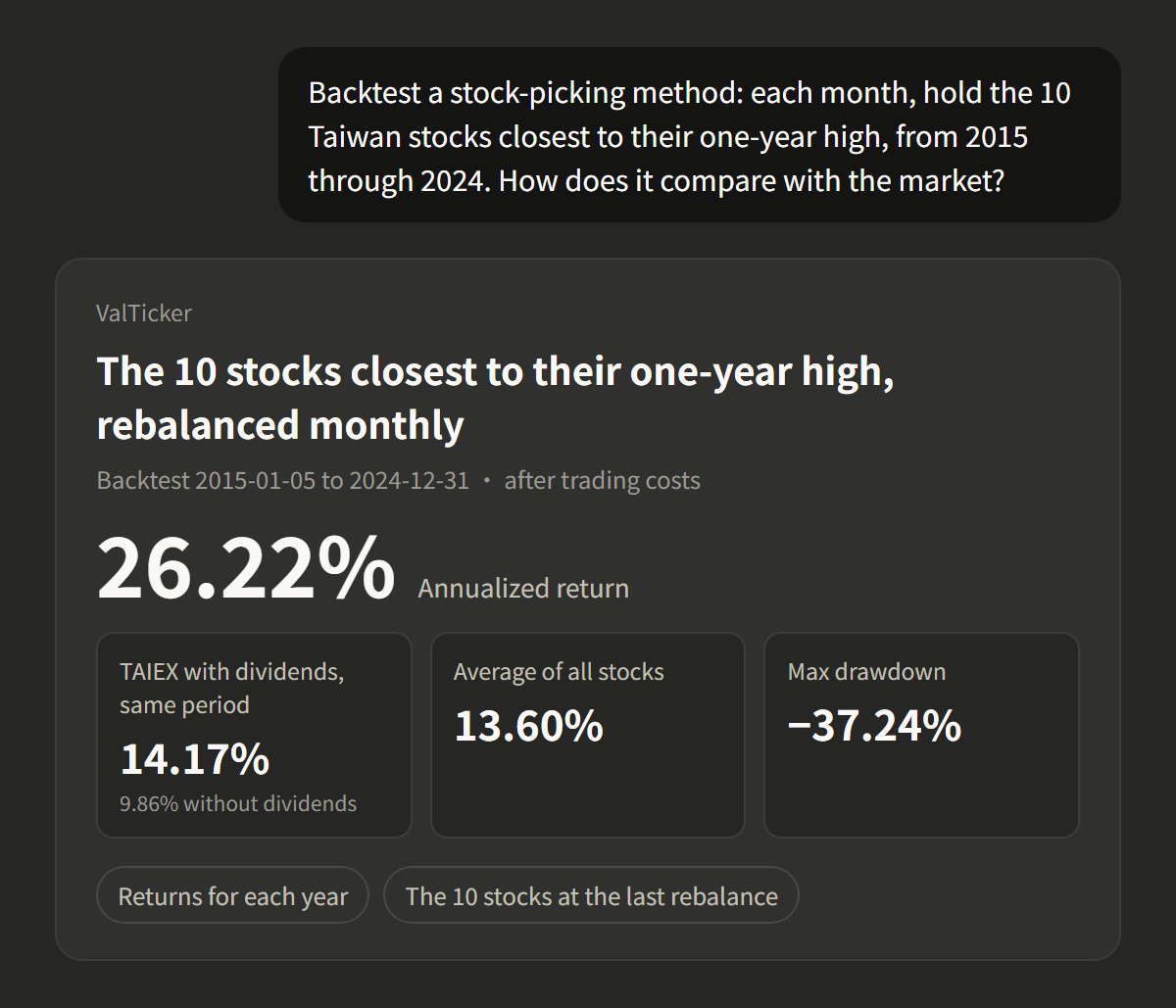
You say:Backtest a stock-picking method: each month, hold the 10 Taiwan stocks closest to their one-year high, from 2015 through 2024. How does it compare with the market?

You get (actual production result, 2026-11-18; the 10 stocks closest to their one-year high, rebalanced monthly; backtest 2015-01-05 to 2024-12-31; after trading costs):

Number
Annualized return26.22%
TAIEX with dividends, same period14.17% (9.86% without dividends)
Average of all stocks, same period13.60%
Max drawdown−37.24%
Also includedReturns for each year, and the 10 stocks at the last rebalance
Track record card: the 10 stocks closest to their one-year high, rebalanced monthly, 2015-01-05 to 2024-12-31, annualized return, maximum drawdown and benchmarks
Sample screenTrack record card: the 10 stocks closest to their one-year high, rebalanced monthly, 2015-01-05 to 2024-12-31, annualized return, maximum drawdown and benchmarks

Example 2: four conditions in one sentence, none dropped

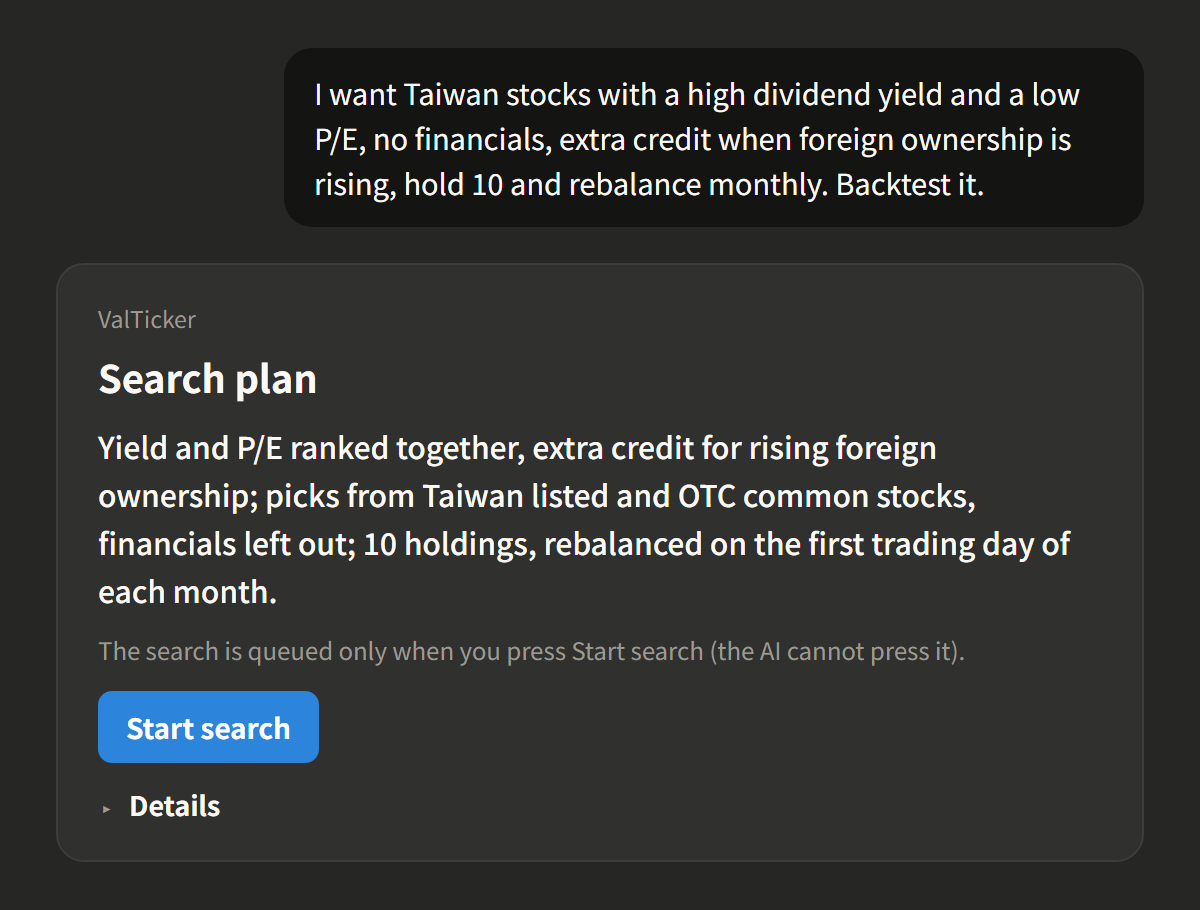
You say:I want Taiwan stocks with a high dividend yield and a low P/E, no financials, extra credit when foreign ownership is rising, hold 10 and rebalance monthly. Backtest it.

Plan card: yield and P/E ranked together, extra credit for rising foreign ownership, no financials, 10 stocks rebalanced monthly
Sample screenPlan card: yield and P/E ranked together, extra credit for rising foreign ownership, no financials, 10 stocks rebalanced monthly

Frequently asked questions

Do I need to learn VQL?

No. It is written by the AI. You describe ideas the way you normally talk, and you see plans, track records and lists.

Can I see what the AI wrote?

You see it in plain words: the stock pool, how stocks are ranked, how many are held, how often they are replaced, what happens when the market weakens. The plan card spells out each item, and nothing runs until you press Start.

How is this different from asking an AI to write a Python backtest?

Python can express anything, including a backtest with look-ahead. This language can only express stock-picking strategies, and look-ahead cannot be written in it. Costs and entry are fixed by the engine, so the numbers come out the same every time.

What kinds of ideas can it express?

Any combination over prices, volume, financial statements, monthly revenue, institutional buying, margin and short balances, foreign ownership, large-holder ownership, P/E and dividend yield: ranking within look-alike groups, streaks of days, time since an event, switching rules with the market, changing exposure on a condition. Of our 90 awkward test ideas, 80 can be written today (70 directly, 10 with a different phrasing).

Is it only for Taiwan stocks?

The language itself is not tied to a market. Taiwan listed and OTC common stocks are live now; more markets are being added, and the same sentence will work on them.

Which AIs does it work with?

Claude, for now: add the connector on a computer and sign in once, and the Claude app on your phone can use it too.

What does VQL stand for?

Valynox Quant Language. VQL is the quant language Valynox designed for AI, and every backtest in ValTicker is written in it.